'Green House'
Variety Coloured Edition

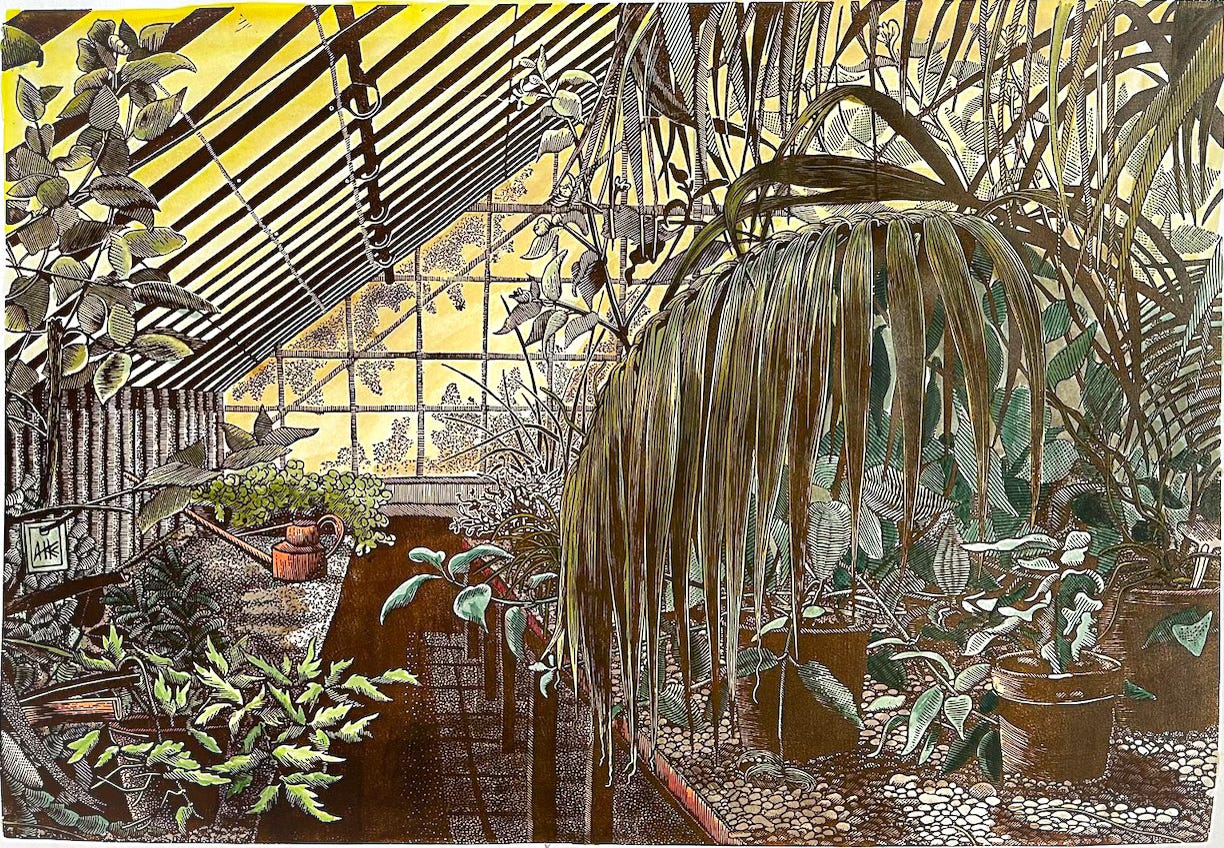
Created in 2022, Green House marked a significant turning point within my practice. Conceived as a large-scale linocut, the work explores the layered interior of a greenhouse — a space suspended between cultivation and wilderness, architecture and organic growth.
» ORDER ‘GREEN HOUSE’
The composition weaves structural grids with dense botanical forms, allowing the rigidity of glass and metal to coexist with the unruly expansion of leaves and roots. Rather than depicting a static interior, the print constructs a living environment — a spatial field in which light, shadow, and growth continually negotiate their boundaries.


The carving process of Green House unfolded over approximately two weeks of sustained, concentrated work. The scale of the matrix demanded both physical endurance and precision: long sessions of cutting dense linear structures, layered cross-hatching, and intricate botanical details. Each area required a different pressure of the tool — architectural grids carved with measured restraint, foliage built through repeated, almost rhythmic incisions.
The image emerged gradually from the surface, not as a single gesture, but as an accumulation of thousands of cuts. The physical resistance of the lino became part of the process, slowing the pace and allowing the composition to develop through time, repetition, and close attention to light and depth.
Following its completion in 2022, Green House began an unexpected and accelerated exhibition journey. What initially emerged as an exploration of architectural containment and organic density quickly entered a wider institutional dialogue.


The work was first recognised with the Society of Wood Engravers Prize at the International Original Print Exhibition in London. It was subsequently exhibited at the Victoria Art Gallery (Bath Society of Artists), Mall Galleries (Society of Botanical Artists), the Royal Society of Painter-Printmakers at Bankside Gallery, and the Royal West of England Academy in Bristol, among other national print exhibitions. Each presentation situated the work within a different context — botanical, architectural, contemporary print — allowing its layered structure to be read through multiple lenses.


In 2022, following my election as an Associate Member of the Royal Society of Painter-Printmakers, Green House was acquired for the RE Diploma Collection. The original edition of 50 impressions sold out in 2023.
Looking back, the trajectory of this print marked a pivotal moment within my practice. It was the point at which scale, technical density, and conceptual clarity converged — and where the work moved beyond the studio into a sustained public and institutional life.


The concerns first articulated in Green House — the tension between containment and growth, structure and organic expansion — continue to unfold in my recent large-scale works. The forthcoming linocut The Shelter extends this investigation further, deepening the spatial complexity and intensifying the dialogue between architectural frameworks and dense botanical forms.
If Green House marked a moment of arrival — a work stepping decisively into institutional space — The Shelter signals a continuation: a more immersive environment, where structure no longer merely frames growth, but becomes inseparable from it.


In 2026, Green House returns in a restrained Brown Variety Edition, limited to 20 hand-coloured impressions. Rather than replicating the original, this interpretation softens the tonal contrast and introduces subtle layers of muted greens, allowing depth to emerge through shadow rather than high contrast.
This edition is not a continuation of the original run, but a reflective gesture — a return to a pivotal work through a slower, more atmospheric lens. If the first edition marked a moment of expansion, this variation inhabits the space of memory: a revisiting of form, light, and structure from a more grounded perspective.
Fabulous.